Ranger
A quiet firewall for Mac. It stops scam sites, ads and tracking in every app, not only the browser, and never interrupts with a pop-up.
- Role
- Solo, with Claude Code: product, design, code, backend, release
- Platform
- macOS 14 and later, Apple silicon and Intel
- Distribution
- Direct, notarized. One-time purchase, 14-day trial
- Localization
- 16 languages
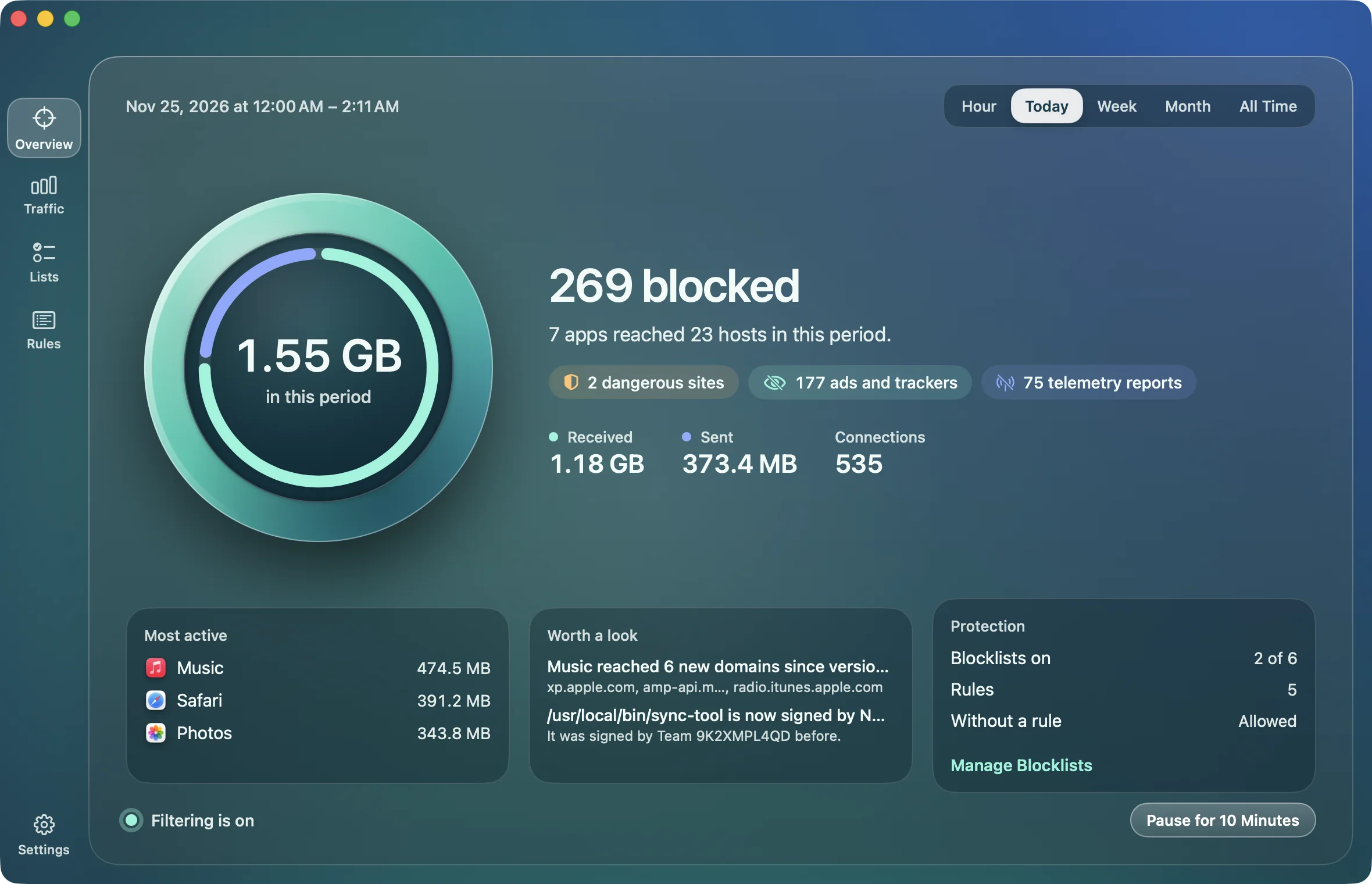
Your Mac talks to strangers all day.
Every app on a Mac keeps in touch with dozens of servers. Most of that traffic is fine: a bank, a mail provider, iCloud. Some of it goes to advertising and tracking networks. And now and then one connection is a trap, such as a fake parcel page or a fake bank login.
Many firewalls ask the user about every new connection. Ranger decides quietly from blocklists and rules, stays out of the way, and shows a clear summary of what happened.
Four parts, one author.
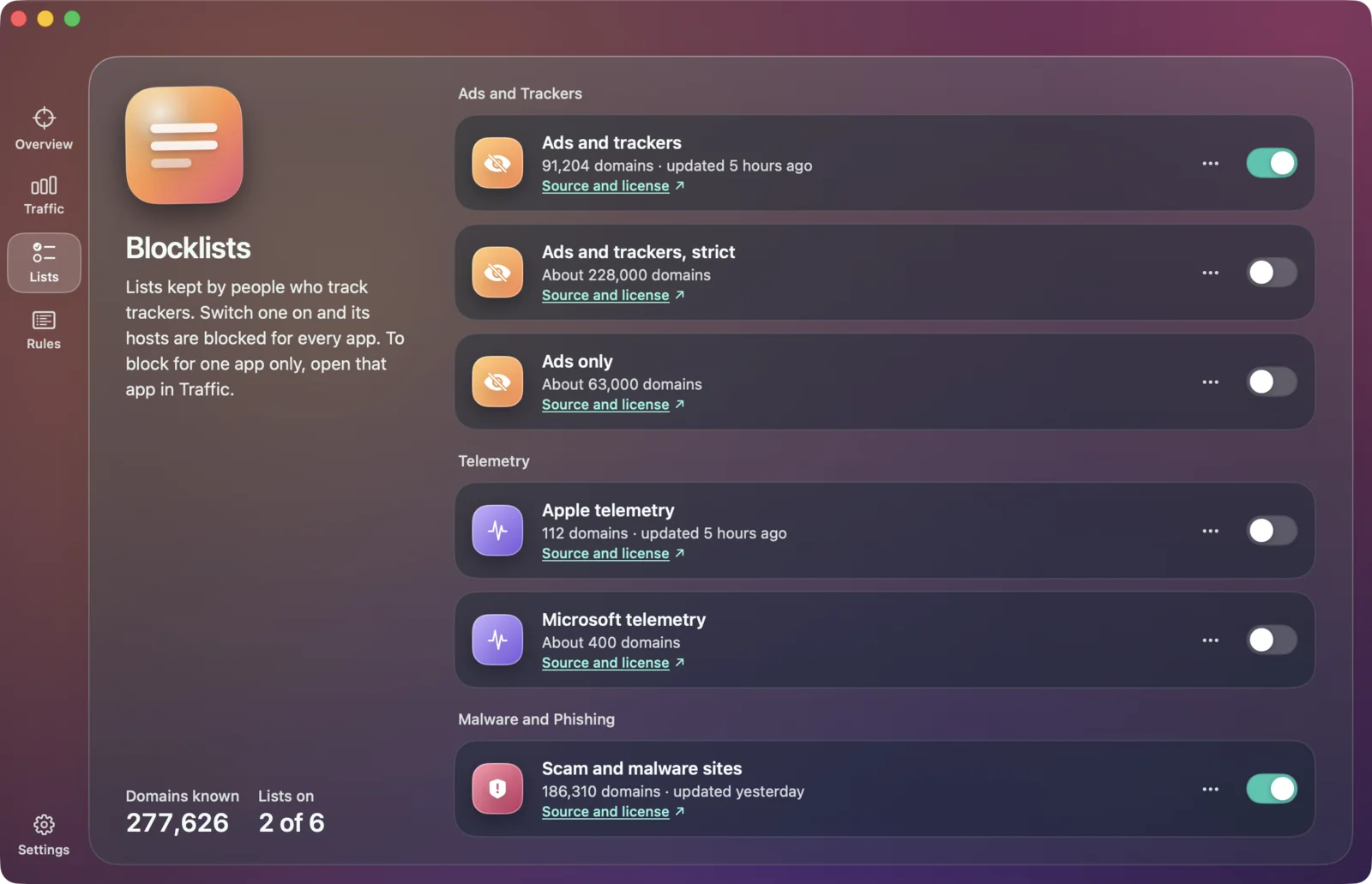
Overview, Traffic, Lists and Rules screens plus a menu bar panel. SwiftUI with AppKit where it is needed.
SwiftUI, AppKit, Observation, Swift ChartsA system extension that sees every new connection from every app and decides by app and by host.
NetworkExtension, NEFilterDataProvider, SystemExtensionsRangerCore, a Swift package shared by the app and the extension, so the logic exists once and is tested once: 185 tests in 33 suites.
Swift 6, SQLite, swift-atomics, Swift TestingTrial and license activation on Cloudflare Workers with D1, and a small Node.js service that builds blocklists.
Cloudflare Workers, D1, Node.jsWhere the engineering is.
Name the server without reading the traffic
For most connections macOS supplies the host name. When it does not, the filter looks at the first bytes the app sends, up to 4096, and finds the name in the TLS ClientHello, the QUIC Initial packet or the HTTP Host header. It also reads DNS answers to learn which name an address belongs to. The content of a TLS connection is never decrypted.
NetworkExtension, TLS ClientHello (SNI), QUIC Initial, DNSData arrives in pieces, and the connection must not wait
macOS hands the filter outgoing data in chunks, each chunk once, and a ClientHello may not fit in one. The filter collects the chunks in a lock-free structure and asks to be called again when more bytes arrive.
NEFilterDataProvider, chunk reassemblyRule lookups take no lock
Rules live in an immutable snapshot. The app sends rules over XPC, the extension compiles a new snapshot and swaps it in atomically, and a decision reads the current one without a lock. Against 200,000 domains a decision takes about 10 microseconds at the median and 41 at the 99th percentile. That is the rule engine alone, over 100,000 lookups, in a debug build on an Intel Core i7-6820HQ.
swift-atomics, XPCKnow which app is connecting
Rules apply per app, so the filter needs the code signature of the process, and reading a signature is too slow for the decision path. The first connection of a new process is paused while the signature is read on a separate queue. If the read hangs, a watchdog lets the connection through as unidentified after 2 seconds.
Code signing, watchdog timerA traffic log that stays fast
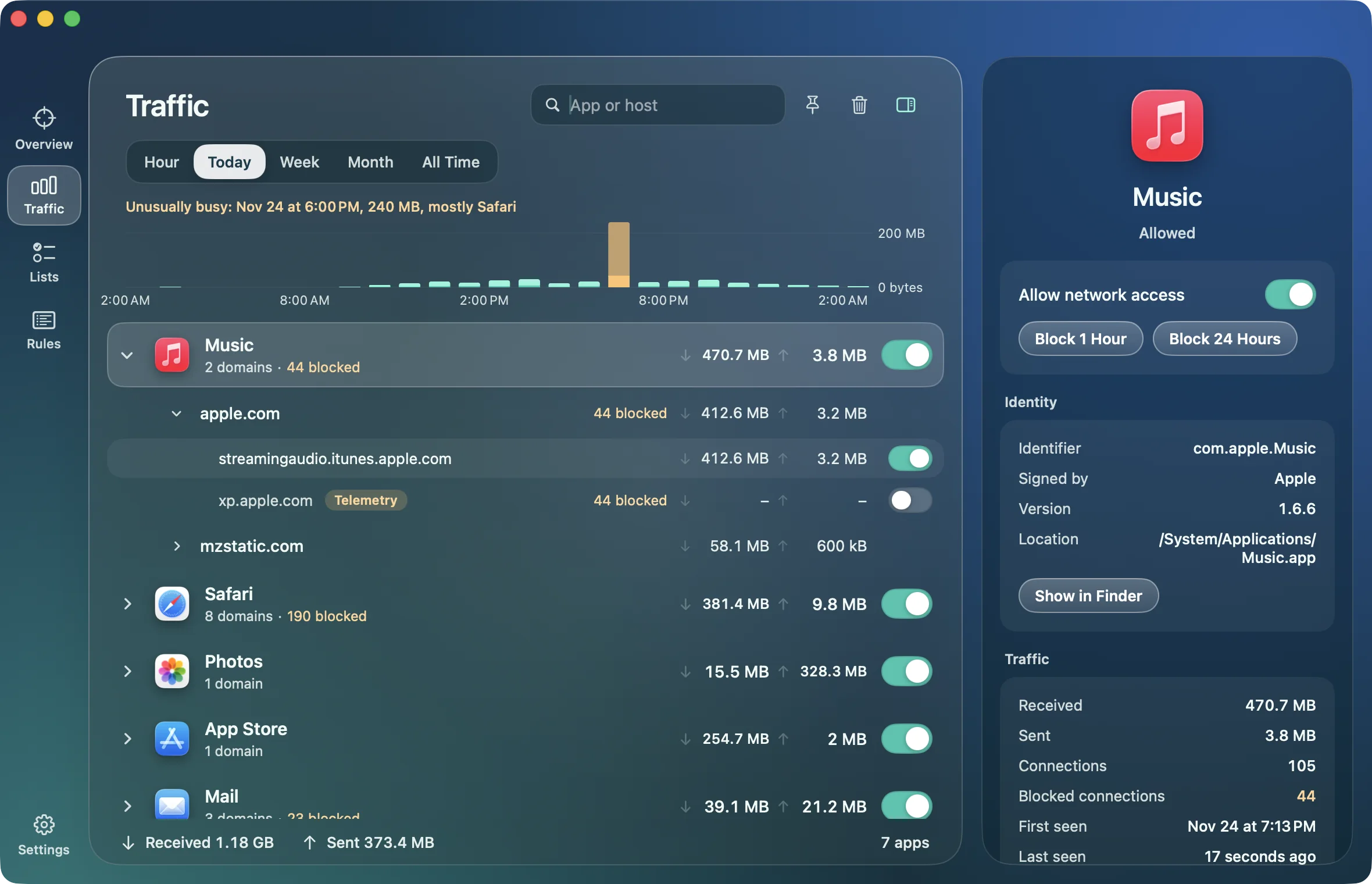
The extension does not store a row per connection. It sums events into one record per user, app, host and hour and writes them to SQLite in one transaction every few seconds. The chart used to regroup the whole history on every refresh, about 26 ms for each day of history. Now a second table keeps totals per hour and app, and the app asks only for the current and the previous hour.
SQLite (C API), hourly rollupAn update must not cut the app off from its filter
When macOS replaces a system extension, the new version registers a few milliseconds before the old one leaves. Both claimed the same Mach service name, launchd left the new one without it, and the app could not reach its filter until a reboot. The service name now carries the build number, so two versions never share a name.
XPC, Mach services, launchdLicenses without accounts
A license is signed with Ed25519 and verified on the Mac with CryptoKit. The trial and activation run on a Cloudflare Worker with a D1 database. The trial asks for no email and no card: the server receives only a hash of the hardware identifier.
CryptoKit, Ed25519, Cloudflare Workers, D1Shipping outside the Mac App Store
Developer ID signing, notarization and the DMG are produced by scripts. Updates go through Sparkle. The app is a universal binary, localized into 16 languages with String Catalogs.
Developer ID, notarization, Sparkle, String CatalogsThe app, screen by screen.
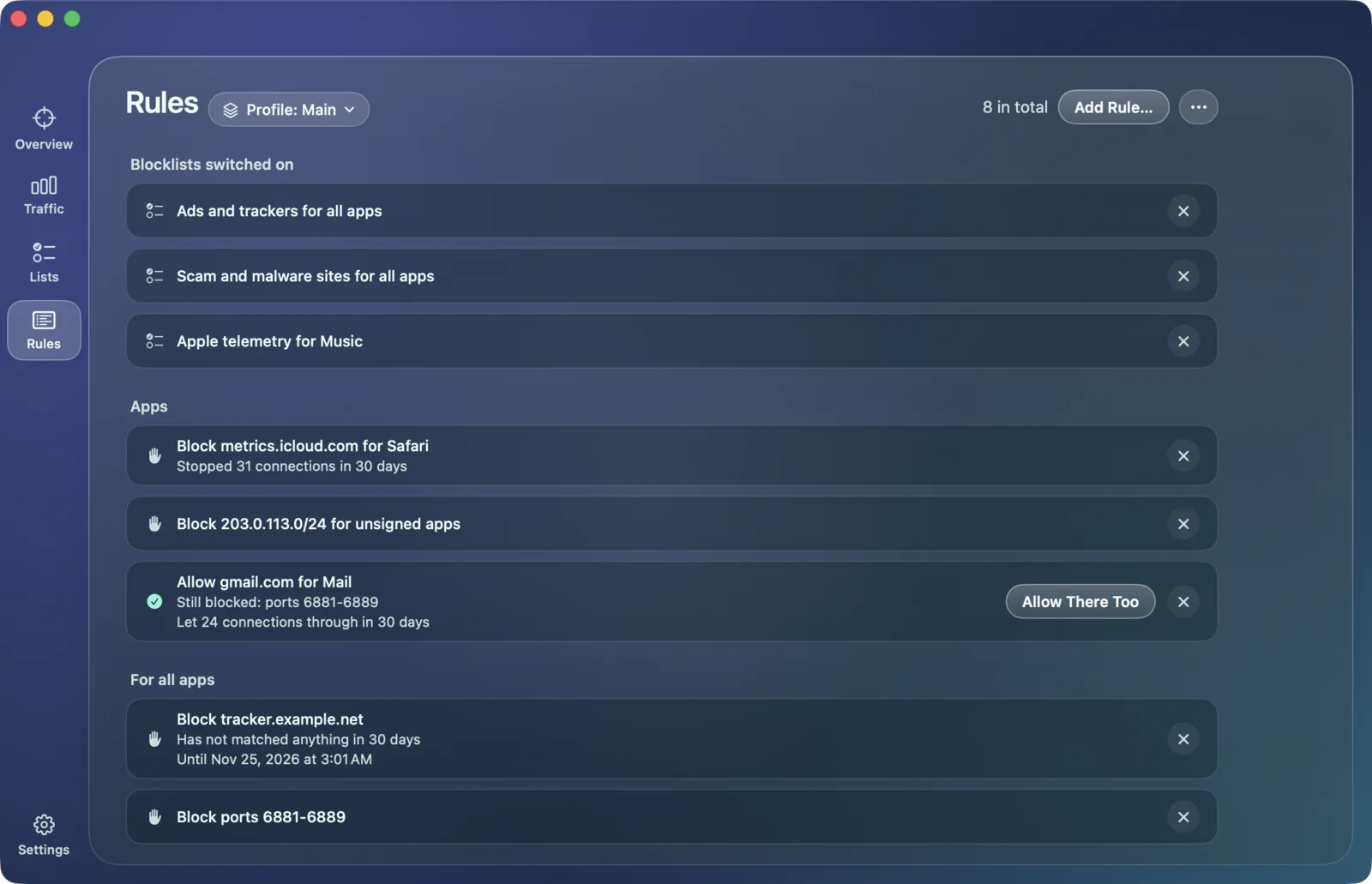
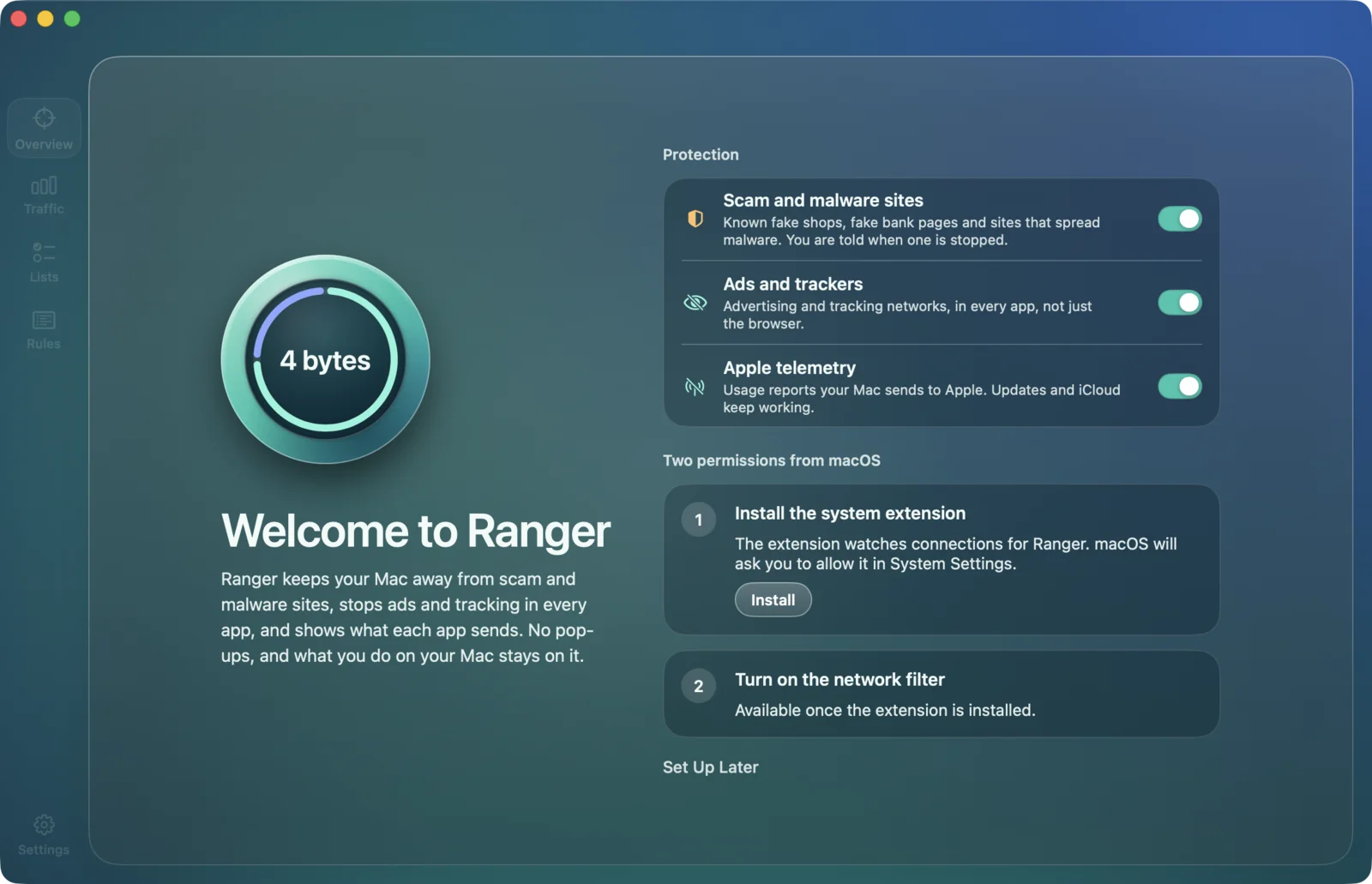
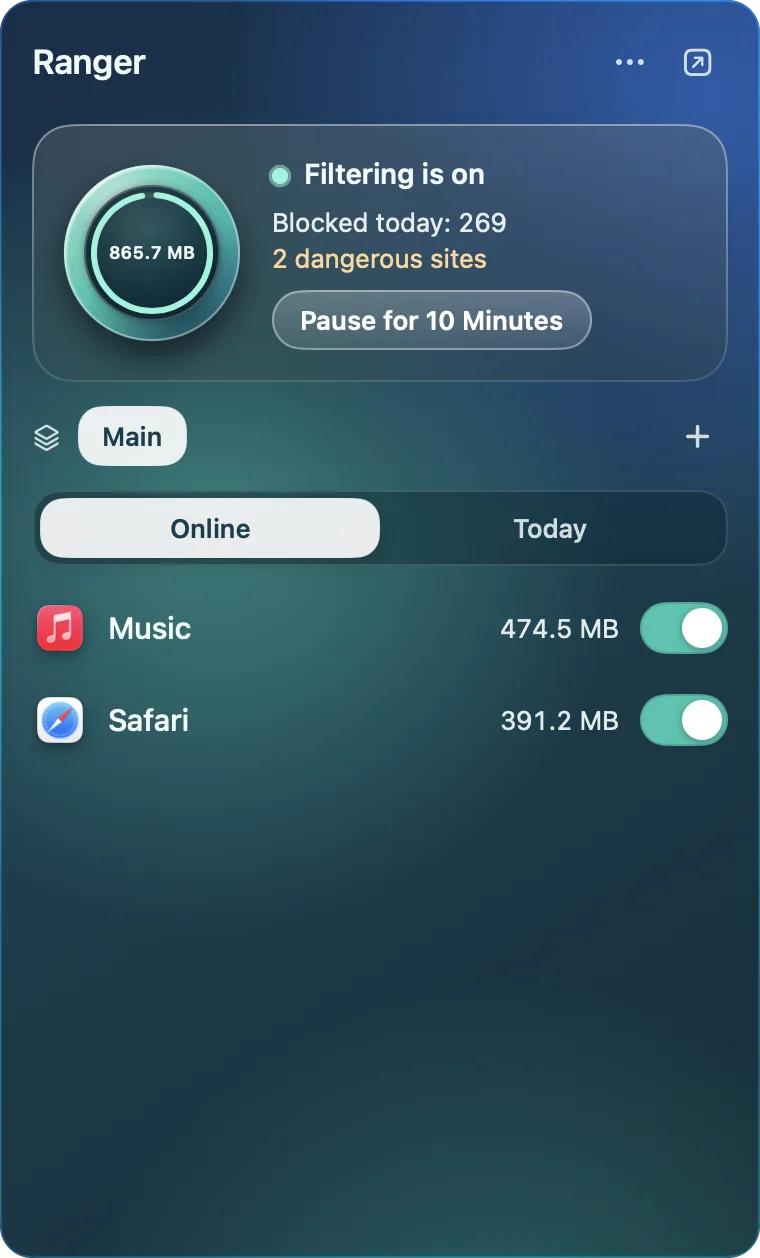
The 21 guides are mine too.
The product site carries 21 guides on Mac privacy and security. I wrote them, and the Python scripts that build them.
All 21 guidesEverything it is made of.
- App
- Swift 6 with strict concurrency, SwiftUI, AppKit, Observation, Swift Charts
- Filter
- NetworkExtension (NEFilterDataProvider), SystemExtensions, Network.framework
- Data and security
- SQLite, CryptoKit (Ed25519), swift-atomics
- Backend
- Cloudflare Workers, D1, Node.js
- Delivery
- Developer ID, notarization, DMG, Sparkle, String Catalogs
- Tests
- 185 tests for RangerCore with Swift Testing, 19 for the two services with the Node test runner
Need this kind of engineering on your team?
I am available now for a senior iOS or macOS role.
 Next case studyCool Sudoku